
Oshkosh Directory Collections by Year
Oshkosh Public Library is the main desk for city directory work. Its local-history resources identify directories beginning in 1857, later street directories, telephone books, maps, newspapers, and house-history tools. Recollection Wisconsin supplies a searchable and browsable digital collection, while the physical library material remains important when a volume is absent online or an image is hard to read.
| Collection | Years | Where held | Access |
|---|---|---|---|
| Oshkosh city directories | Beginning in 1857 | Oshkosh Public Library | Library and selected digital volumes |
| Digitized directories | Multiple historic editions | Recollection Wisconsin | Free search and browse |
| Regional archive records | Varies by series | UW Oshkosh Archives | Finding aids, staff help, and research orders |
| Local historical holdings | Varies by collection | Winnebago County Historical Society | Public hours or appointment |
Coverage is not the same as a complete annual run. Check the catalog or ask staff about the exact year before visiting. A missing edition does not end the search: use the closest earlier and later volumes, then compare census, deed, newspaper, and cemetery records.
Search Oshkosh City Directories Online
The Recollection Wisconsin directory collection can be browsed by volume and searched for names or words. Optical text recognition may misread small type, initials, or worn pages. Try a surname alone, a street without its suffix, and common spelling variants. Browse the page image when the text search gives a promising result.
The digital collection also includes material from nearby communities. Confirm that the title page names Oshkosh before treating an entry as local. The source interface is shown below; its volume structure helps explain why year-by-year browsing often beats one broad search.
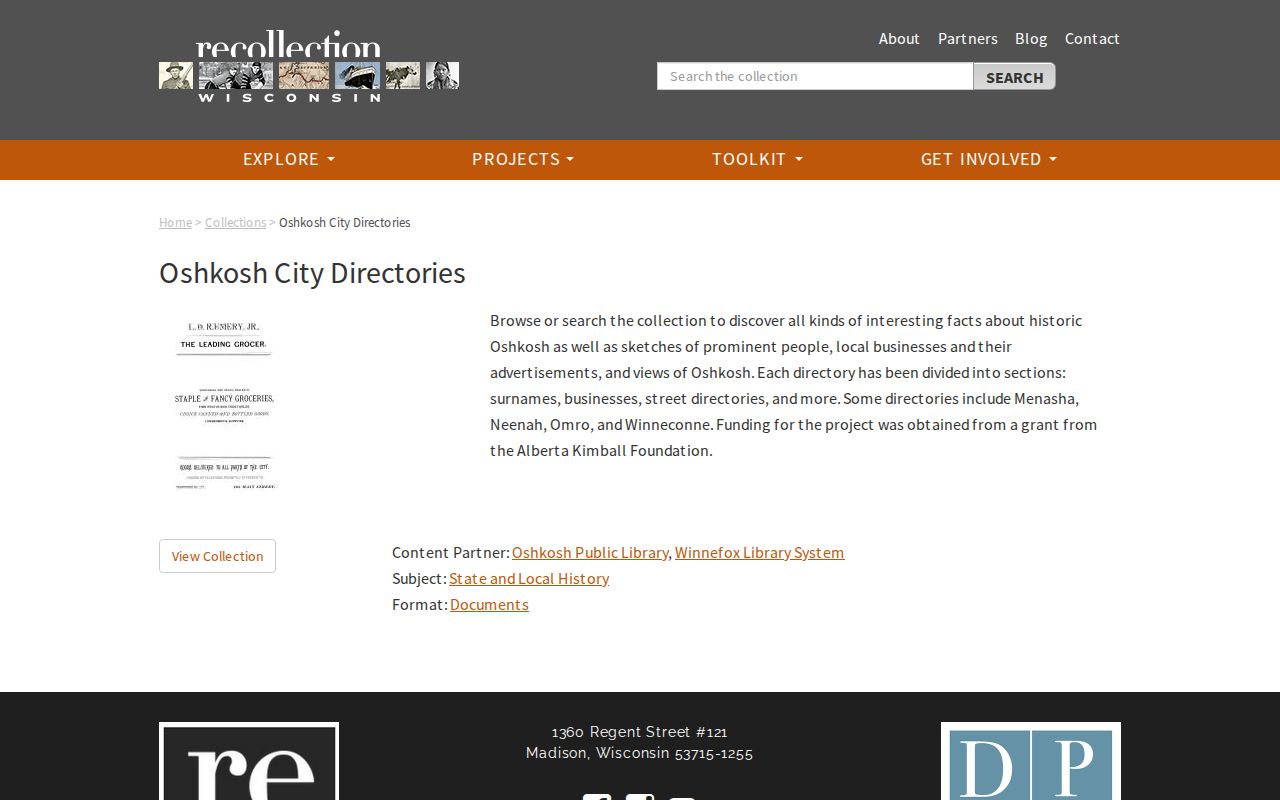
Once a page is found, save the volume year and printed page number. Those details let library staff retrieve the same entry and help distinguish one edition from another.
Read an Oshkosh Directory Entry
Older city directories compress a great deal into one line. The abbreviation key at the front of each volume is part of the record, not optional fine print. It may explain a spouse marker, occupation code, employer, home address, business address, or whether a person boards at the location.
- Householder index
- A listing arranged by the name of the person treated as head of the household.
- Criss-cross directory
- A later directory arranged by street and house number instead of surname.
- Abbreviation key
- The volume's guide to shortened jobs, street types, household terms, and symbols.
- Residence
- The home address in that edition, which may differ from a work address.
Copy the full line and its punctuation. Do not expand an abbreviation by guess. A widow notation, for example, can point to a spouse and lead to an obituary or death record, while a job and employer can separate two residents with the same name.
Trace Oshkosh Households Across Editions
A city directory is most useful as a sequence. One entry shows a moment; several show arrival, departure, a new job, or a move across Oshkosh. Work outward from the firmest year.
- Find the resident in one known edition and transcribe the complete entry.
- Check the prior and next available editions for the same surname and address.
- Compare household names with the nearest federal census year.
- Use the street index when the surname disappears but the family may have stayed.
- Verify deaths, marriages, or ownership changes in official records.
The directory is evidence of a published listing, not proof that every person slept at that address on publication day. Publishers gathered data before printing, skipped some residents, and carried errors forward. Pairing editions with census and deed sources makes the conclusion stronger.
Oshkosh Streets Changed in 1957
Oshkosh adopted broad street-name and house-number changes in 1957 and 1958. That local quirk can make a correct old directory entry look unrelated to a current parcel. The Oshkosh Public Library local-history collection preserves address-change material and other tools for translating the old grid.
Search both forms of the address around the change. Compare the resident, cross streets, parcel description, and map position. A literal search for today's number in an older volume may fail even when the same building and household are present.
Note: Street conversion records should be checked before concluding that a household moved during the 1957 to 1958 change.
Oshkosh Library Research Routes
The library's house-history guide combines directories with title chains, maps, assessment rolls, photographs, and numbering history. The guide is a strong fallback when digitized name search fails. It turns a directory result into a building history and shows which source should come next.
The library page pictured below groups those local sources around a practical address workflow. It also shows why printed and staff-assisted records remain useful beside the online volumes.
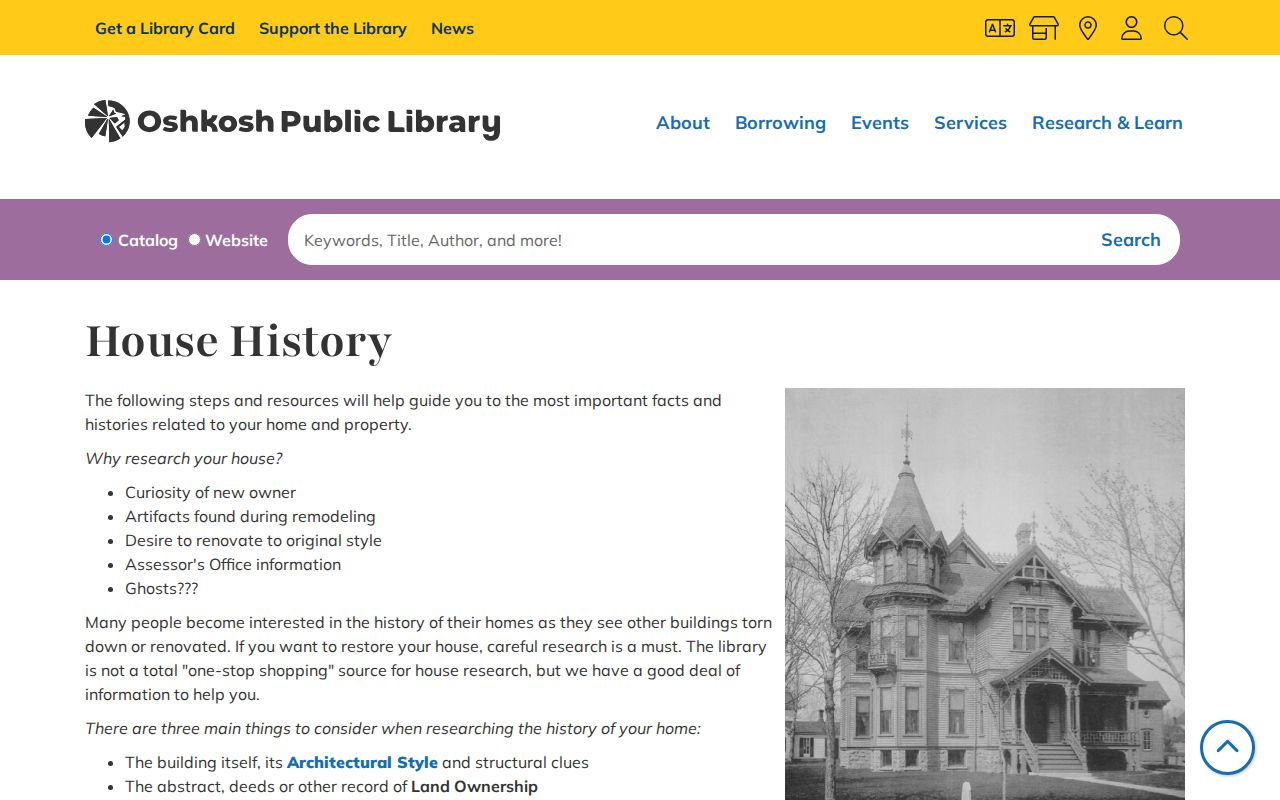
Bring the exact address, known former number, approximate years, and every spelling found. Staff can then check sources that lack a public name index instead of repeating the same online search.
Expand an Oshkosh Directory Find
UW Oshkosh Archives genealogy resources extend a directory search into civil, probate, naturalization, tax, property, newspaper, and map material. The indexed local court search covers much nineteenth- and twentieth-century civil and naturalization material, though the index does not supply every file image. A finding is a route to the archival record.
The Winnebago County Historical Society and Oshkosh Public Museum Archives add photographs, maps, oral histories, record groups, and local organization material. Contact them with names, dates, and addresses rather than a broad request. Their staff may recognize a neighborhood, firm, or family name that an online index cannot connect.
Oshkosh Directory Evidence and Limits
Directories were private publications, not official population counts. Children may be absent, spouses may be reduced to a first name or initial, and people who declined to answer may not appear. Dates printed on a cover can also trail the date when information was gathered.
Use the edition as a dated lead. Verify a modern identity through the focused Oshkosh resident lookup, and use certified records when a legal or estate matter requires proof. For family history, record negative searches too; a gap between volumes can show when a resident likely arrived or left, but it should not be treated as an exact move date.